


Scroll down

Our first ever Food and Agriculture Benchmark measures and ranks 350 of the world’s most influential food and agriculture companies on their contributions to transforming our global food system. The benchmark builds upon existing frameworks and targets to holistically assess companies from farm to fork on their environmental, nutritional and social impact.
The benchmark is launching alongside the 2021 United Nations Food Systems Summit, a critical moment for addressing the interconnectedness of food systems and global challenges such as hunger, climate change, poverty and inequality. Whilst pressure on the food sector is mounting, many major companies continue to operate business as usual and not contributing to achieving the Sustainable Development Goals (SDGs).
Five key findings
The benchmark demonstrates that the food and agriculture sector is not on track for transitioning to a sustainable food system. Our key findings reveal worrying gaps in the industry’s preparedness for climate change, progress on human rights and contribution to nutritious diets. The benchmarked companies account for more than half of the world’s food and agriculture revenue, and directly employ over 23 million people. If these companies do not take action now, the SDGs and the Paris Agreement will be further out of sight than ever before.
KEY FINDING
Food companies need to step up for SDG decade of action
The companies that dominate our global food system are not putting people at the heart of their business or addressing their environmental impact. Providing sustainable livelihoods for farmers, decent employment for workers and nutritious choices for consumers – without depleting natural resources – is essential for the SDG agenda. Yet, the majority of companies perform very poorly.

To have a food system that is fit for present and future generations, food companies have a responsibility to address the environmental, nutritional, and social impacts of their operations and value chains. The sector is a leading contributor to climate change, land degradation and biodiversity loss, risks which have the potential to negatively affect the livelihoods of 500 million smallholder farmers, including some of the world’s most vulnerable people. Additionally, more than one-third of the world’s population cannot afford a healthy diet. The number of people going hungry has risen since the start of the century, and has further increased as a result of the COVID-19 pandemic. Whilst a handful of companies are demonstrating that they are taking necessary steps to implement a sustainable agenda across their business practices, the sector as a whole needs to substantially improve their actions and impact.
Leading companies from nearly all segments of the value chain
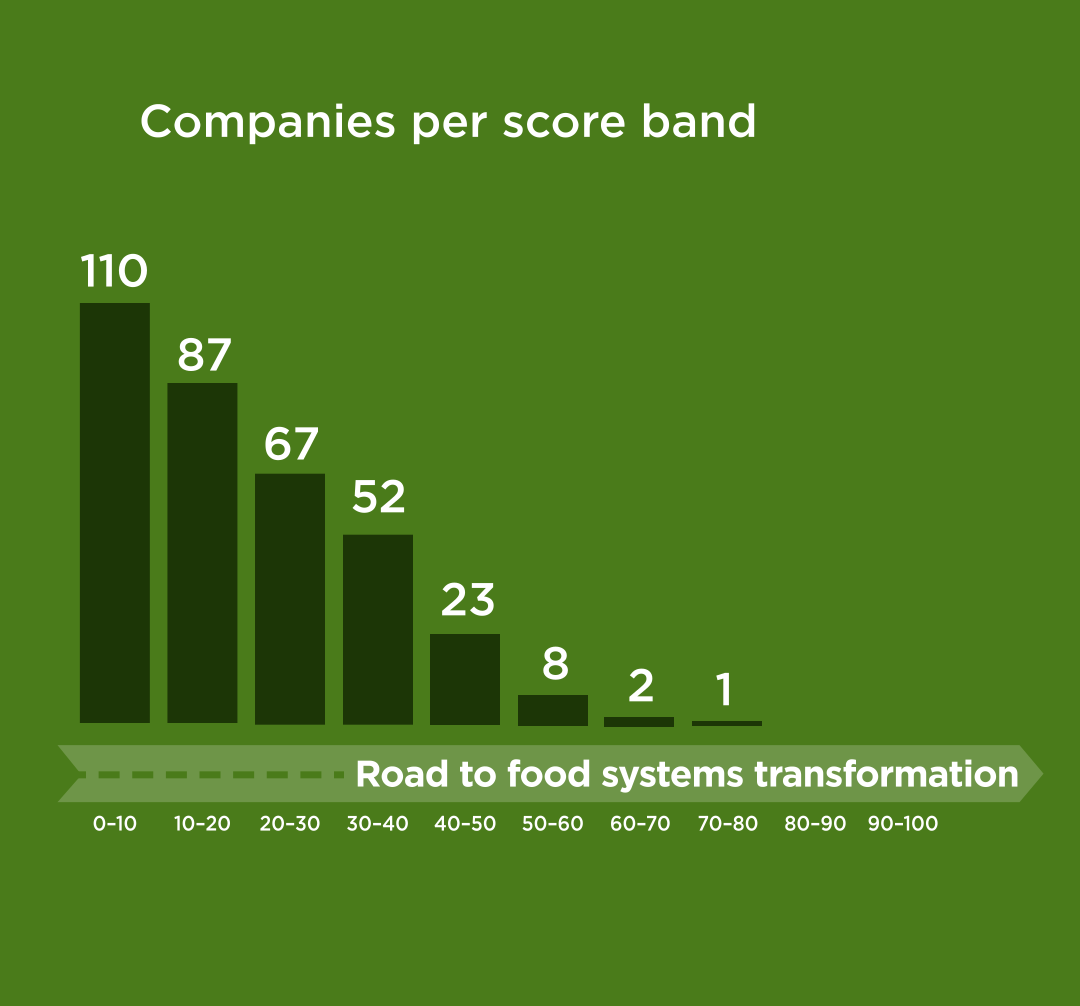
Of the 350 companies in scope, only 11 scored over 50/100 in their assessment. Although there is clearly room for improvement by all, interestingly, one company from five of the six-value chain segments was represented across the top performers. The only segment that did not score over 50/100 are the restaurants & food service companies. This demonstrates that leadership and positive change can and must come from every part of the value chain, supporting the WBA’s guiding principle that a company of a certain size and influence can and must contribute holistically across the food systems transformation agenda.
Most companies are operating outside the spotlight
Unilever, Nestlé and Danone, well-known brands, top the overall ranking. Beyond the top performers, scores decrease rapidly. Most strikingly, 229 of all companies assessed are performing below 25/100. However, most of the targets and commitments that companies have set need to be realised at farm level or in the supermarkets and restaurants. If conditions are to improve for the millions who depend on agriculture for their livelihood and the most vulnerable families that cannot afford a healthy diet, we need all companies across the value chain to take action and recognise the role they play in the larger system.
From the 229 companies that score below 25/100 on the benchmark, 78 companies score below 10/100 and an additional 32 companies score 0/100. These companies choose to disclose little or no information and do not publicly acknowledge the impact they have on the environment, their workers and supply chain partners and the nutritional intake of people who eat their food. We need these companies to come to the table, take part in the conversation and share the risks and opportunities they face, so that ultimately they can achieve meaningful impact in the system in which they operate.
Sustainability strategies are a crucial first step
Integrating sustainability into a business’s strategy is the first step, however companies must go beyond words and set actionable targets. While in total 73% of companies have a sustainable development strategy, only 26% are setting holistic time-bound targets. Concerningly, 27% of companies did not disclose any sustainability strategy.Read moreKEY FINDING
The sector is not taking environmental responsibility
The world is becoming ever-more conscious of the climate-impact of our food system, yet our results find that only 26 companies have set greenhouse gas (GHG) emission reduction targets aligned with the Paris Agreement. Furthermore, 189 companies have not set targets to achieve deforestation and conversion-free supply chains for their high-risk commodities.Read moreKEY FINDING
The food business is failing people
Companies are performing poorly on critical social issues. The vast majority lack comprehensive commitments and procedures prohibiting child and forced labour in their operations and supply chain. Less than 10% of companies demonstrate having a full human rights due diligence mechanism in place.Read moreKEY FINDING
Industries are not prioritising nutritious food choices
The 350 companies assessed dominate international markets. They impact what ends up on the plate of the billions of consumers across the world. However, the majority of companies struggle to tackle nutritional and health challenges in their core business and strategy. 80% of companies in scope do not provide evidence of improving accessibility and affordability of nutritious foods.Read more
See how the companies performed

Further reading
- DataAll the benchmark results and data are publicly available and downloadableSee data
350 Food companies worldwide
Source: www.worldbenchmarkingalliance.org