


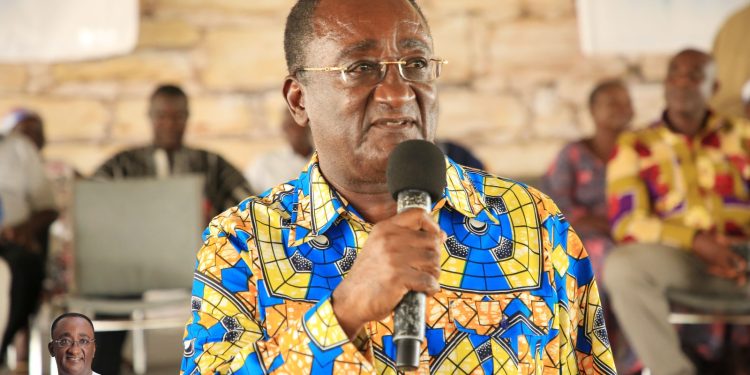
He believes development partners are the driving force behind the sustainability of the country’s food security and nutrition.
According to him, increased investment in smallholder farmers would further boost food production, where there would be enough to feed families across the country and export the surplus to earn foreign exchange.
The Cambridge University scholar emphasised the need for the country to prioritize increased investments in smallholder farmers, who account for 90% of the country’s agricultural output.
He made these when he addressed a gathering on Tuesday, February 13, 2024, as the Distinguished Guest Speaker at the launch of the 70th-anniversary celebration of the Faculty of Agriculture, Kwame Nkrumah University of Science and Technology (KNUST).
The former two-term MP for Kwadaso, noted that rising global tensions over the Russia-Ukraine war and the recent Israeli-Gaza conflict threaten Ghana and the continent’s food security outlook.
“We can only look within for food sufficiency in the medium to long term.”
The solution to this seeming threat, he noted, is to look within for food sufficiency in the medium to long term, emphasizing the opportunities smallholder farmers would bring to the country with increased investments in them.
“The more the threats of the looming global crises unfold, it becomes increasingly clear that Ghana’s political independence, economic transformation and the survival of its youthful population would depend on a robust economy that has agriculture as an unconditional priority,” he noted.
He added, “It is encouraging to note that an increasingly youthful population yields higher levels of consumption, which must directly convert to advantages that boost local food production and Ghana’s economy as a whole. To this end, it is imperative to support smallholder farmers, who continue to produce some 90% of our national food requirements.”
According to Dr. Akoto, the Ghanaian smallholder farmer is a potential resource waiting to be tapped into, believing that more investments in their farming activities hold the key to Ghana’s agricultural transformation drive.
Highlighting some of the successes he made when he was at the helm of affairs as the Minister for Food and Agriculture, Dr. Akoto said the right investments he made in improved seeds and fertilizer to support smallholder farmers led to record annual growths in the agricultural sector in Ghana.
“In the period 2017 to 2021, the Government invested Gh₵2.6 billion in subsidy to procure and distribute 1.4 million MT of fertilizer and 93,192 MT of improved seeds to over 1.7 million farmers. The number of extension officers was doubled from 1,450 to more than 3,000 to strengthen the link between science and the farmers. The Government of Canada made a strategic contribution by donating 300 pick-up vehicles and 3,000 motorcycles to promote extension services to farmers.
These investments in 2017-2021 generated farm output worth Gh₵47.5 billion at the farm gate. This represents a huge economic rate of return on public expenditure of GH₵2.6 billion under the Planting for Food and Jobs Programme,” he explained.
On June 28, 2023, the World Economic Forum reported that in regions of the world with a young population and a high number of commodity-dependent countries, such as in Africa, investment in small and medium-sized agribusinesses (agri-SMEs) with processing capacity creates much-needed economic opportunity, reducing migration and building prosperity for future generations. In Africa alone, SMEs provide an estimated 80% of jobs across the continent, thereby, powering growth.
Smallholder farmers make up an incredibly important piece of the global food system — the Food and Agriculture Organization of the United Nations estimates that around 35% of the world’s food comes from farms with less than 5 hectares in size.
However, these farmers receive only 0.3% of global climate funding, and they’re consistently the ones hit the hardest by climate shocks such as floods and droughts.
The FAO estimates that “Increasing investment in smallholder farmers is essential to realizing the future we want.”
source: citinewsroom